
Whether you’re just starting to learn to drive or preparing for your test, mastering bay parking is essential. It’s one of the three manoeuvres you might be asked to perform during your UK practical driving test — and it’s also something you’ll use regularly in the real world.
At Bill Plant Driving School, we teach thousands of people to drive every year, so we know a thing or two about performing manoeuvres. In this guide, we’ll walk you through forward and reverse bay parking with step-by-step instructions, handy diagrams, tips from our instructors, and an instructional video to make it all easy to follow.
So, buckle up, and let’s get started.
What is Bay Parking?

Bay parking involves manoeuvring your car into a marked parking bay. There are two ways to do this:
- Forward Bay Parking – drive into the space and reverse out.
- Reverse Bay Parking – reverse into the space and drive out.
Reverse bay parking is often safer and easier because you can see more clearly as you exit the bay. However, it won’t always be possible to do this, so you must be familiar with reverse and forward bay parking.
Why Learn to Bay Park?
Bay parking is part of your practical driving test, with a 1 in 3 chance you’ll be asked to perform this manoeuvre. It also prepares you for everyday scenarios like parking at supermarkets or car parks.
During your test, typically at either the start or the end, the examiner will tell you whether they want you to perform a forward bay park or a reverse bay park, and they’ll give you plenty of warning to give you time to prepare.
Examiners look for:
- Good control of your vehicle
- Accurate positioning within the lines
- Constant observations for hazards
How to Forward Bay Park
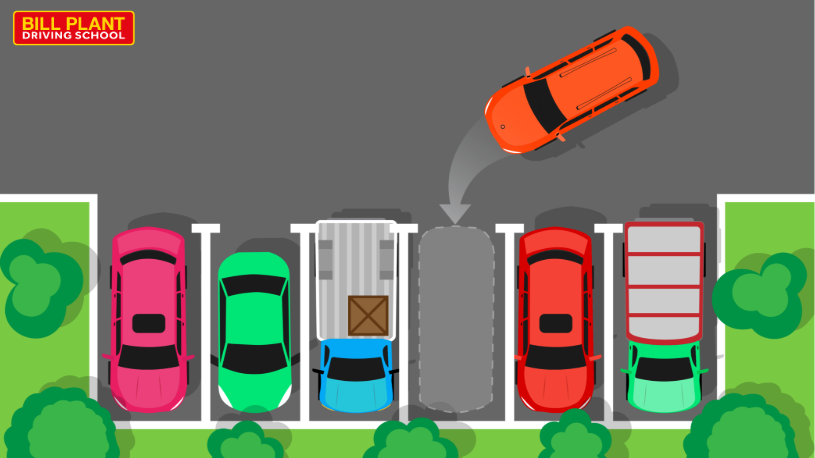
- Choose your bay – Preferably one with no cars beside it, as it’s much easier to park in a space with no cars on either side. Bays on the right often give more room to turn. For these steps, we’re going to assume you’re choosing a bay on the right-hand side.
- Find your reference point – Once you’ve chosen your available parking bay, check your interior mirror, right-wing mirror and blind spots.
- Position your car – Having made sure there is no oncoming traffic, put on your indicator and slowly move left to create space. Align the first white line of the bay just under your right-wing mirror.
- Steering into the bay – It’s imperative to perform another check of your mirrors and blind spots, as this is something that your examiner will be looking out for during your driving test. Steer full lock right (or left if parking on the left side) and slowly enter the bay.
- Straighten up – When the car is aligned with the bay, straighten the wheel and drive forward slowly.
- Stop and secure – Once fully in the bay, apply the handbrake and select neutral.
Reversing Out
- Check all mirrors and blind spots, and select the reverse gear.
- Reverse slowly until about a third out of the bay.
- Apply full lock in the opposite direction and carefully exit.
How to Reverse Bay Park

Instructions assume you will reverse park into a bay on the left, so complete these instructions in the opposite direction if you opt for a bay on the right.
- Pick your bay – Choose a space with room to manoeuvre.
- Position your car – Position yourself about a car’s width from the bay. Stop two car lengths past the space. You’ll want to indicate to let other road users know your intention.
- Find your reference point – Line up the middle of your passenger door with the white line two along from your chosen bay.
- Select reverse gear and make all-round observations.
- Start reversing – Steer full lock into the bay and reverse slowly.
- Check your mirrors – You should see the bay lines appear in your wing mirrors.
- Straighten the wheel – As soon as you become parallel with the two white bay lines, straighten your steering wheel and slowly edge backwards until you’re far enough into the bay.
- Stop and secure – Apply the handbrake and place the car in neutral.
Driving out of the bay
- Check all your mirrors and blind spots to ensure it’s safe.
- Move forward out of the space slowly, until your car is around one-third out of the space.
- Turn the wheel in the desired direction and safely drive away.
How to Reverse Bay Park with Reference Points
To help with accuracy and confidence, many learners use four key reference points when reverse bay parking. These instructions assume you’re parking into a bay on the left-hand side:
- Reference Point A – Pull two car lengths past the chosen bay and line up the middle of your passenger door with the white line two along from the bay.
- Reference Point B – When you begin reversing and steering full lock, the left-hand bay line should appear in your left wing mirror.
- Reference Point C – As you continue on full lock, the right-hand bay line will appear in your right wing mirror.
- Reference Point D – As both white lines appear evenly in your wing mirrors, straighten the steering to finish neatly in the bay.
You may need to make small adjustments, and that’s okay – just ensure you maintain control and complete observations throughout.
Will I Reverse Bay Park on My Driving Test?
Possibly. Since December 2017, the DVSA practical driving test includes one of the following reversing manoeuvres:
- Parallel parking at the side of the road
- Pulling up on the right-hand side, reversing, and rejoining traffic
- Bay parking (forwards in and reversing out, or reversing in and driving out)
You’ll be told in advance by your examiner which one you’ll be performing. It may take place at the beginning or end of the test.
You won’t be allowed to drive through one bay into the next, or reverse beyond the marked bays. Choose a space where you can clearly see both lines, and always follow any one-way systems.
FAQs About Bay Parking
Can you fail your driving test on bay parking?
Yes, if you show poor control, observation, or fail to finish between the lines. But you are allowed to adjust if needed.
What happens if you fail the reverse bay park in your test?
It may result in a minor or major fault depending on severity. One mistake doesn’t always mean a fail.
Do you need to indicate when bay parking?
Yes, it’s good practice to signal your intentions to other drivers.
Is it illegal to park over two bays?
Yes, this could result in a fine or penalty notice in many car parks.
Top Tips for Bay Parking
- Go slow, steer fast: Take your time, especially when turning into or out of a bay.
- Use reference points: Know when to turn by spotting the correct mirror alignment.
- Readjust if needed: It’s okay to straighten up or start again.
- Be aware of surroundings: Always look out for pedestrians, cars and signage.
- Practice both directions: Try left and right bay parking to build confidence.
Related Learning Resources
Want to brush up on your driving test basics? Explore more from our “The Basics” series:
- How to Change Lanes
- How to Use Car Gears
- How to Adjust Mirrors
- How to Set Up Your Steering Wheel
- How to Start, Move, and Stop
- How to Set Up Your Car Seat
- Oncoming Traffic
- How to Parallel Park
Bay Parking: Main Takeaways
The bay park manoeuvre is a crucial aspect of driving lessons, and you’re likely to use it frequently after passing your test.
Here at Bill Plant Driving School, our expert instructors can teach you the best techniques for any manoeuvre, as well as everything else you need to know when you learn to drive.
Bay parking may seem a bit daunting initially, but we can help take the stress out of driving and get you performing this manoeuvre and much more in no time.
Want expert help mastering your manoeuvres? Find your nearest driving instructor and book with a qualified Bill Plant Driving Instructor today.